
We’re drowning in data, but we’re not unlocking the full value from our investments – Alex Langshur, Cardinal Path
It’s less than 2 weeks to go until The Most Important E-Commerce Event in Central and Eastern Europe, GPeC Summit May 25-26-27, event where 30+ world-class e-commerce and digital marketing speakers will go on stage. One of our special guests for this edition of GPeC Summit is Alex Langshur, Co-Founder Cardinal Path – one of the most important agencies in Digital Performance Measurement in North America, recently acquired by the Dentsu Aegis Network, a media giant with business on 5 continents. At the same time, Alex is the former President and current Director Emeritus of the Digital Analytics Association (DAA) – the most important web analytics agency in the world.
We discussed with Alex in the following interview about e-commerce metrics, conversion rate optimization and online marketing hacks. He also gave us a few more insights on his keynote speech from the first conference day at GPeC Summit May 25-26-27. Here is the interview:
1. What do you think is the most important metric for online stores?
To paraphrase George Orwell: “All metrics matter, but some matter more than others.”
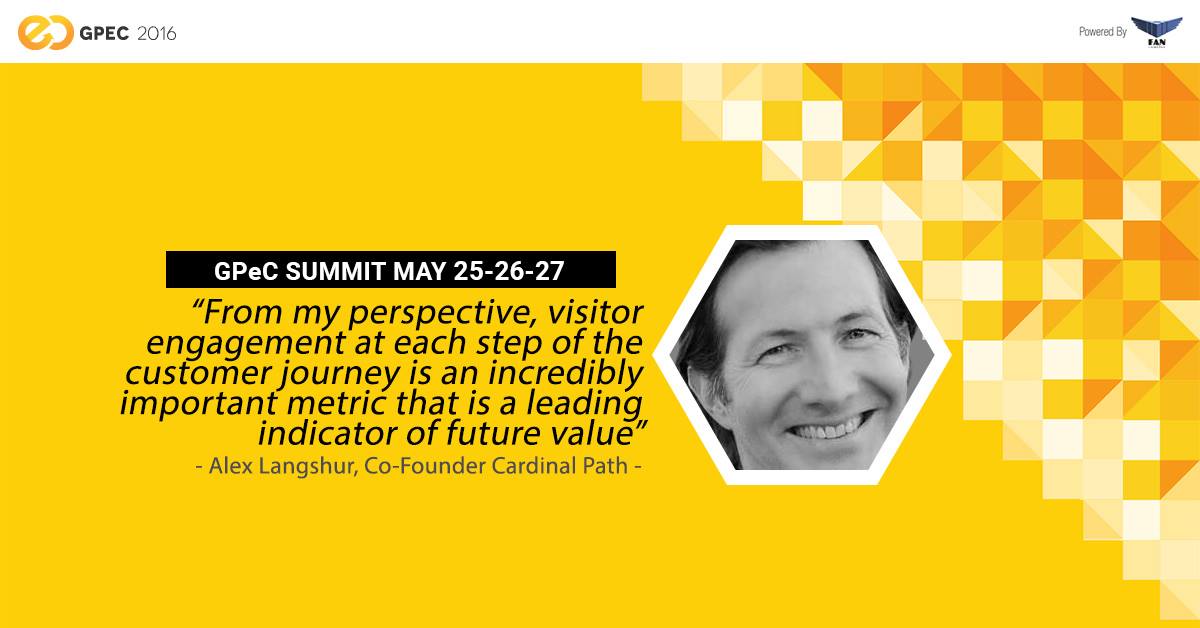
It’s easy to say sales metrics are the most important, and while this is true (sales metrics are certainly critical), we also have to remember that the path to purchase is not linear. People don’t necessarily buy on their first visit. The questions organizations need to ask is: Are we creating a relationship? Are we fostering conversations (metaphorically speaking) built on value exchange and non-manipulative engagement that will lead to real relationships? Are we identifying and segmenting our visitors and speaking to them appropriately? Am I capturing enough data about each visitor in order to surface content that matters, informs and delights them? From my perspective, visitor engagement at each step of the customer journey (and by audience segment) is an incredibly important metric that is a leading indicator of future value.
2. How can Cardinal Path help online shops unlock the value of their data?
Data activation is actually a very tough problem and a key challenge for businesses today. At Cardinal Path, we have what we call the “Cardinal Path”, which is an approach that looks at business value vs. digital maturity across three areas of focus: 1) technical; 2) business; and 3) strategic. The approach begins first with making sure that the foundation is in place so the data being collected is robust, comprehensive and accurate. This is the Technical layer, where you need to ensure the plumbing is done right, that data is integrated, and 3rd party data sources are connected. In the Business layer, it’s about putting in place the levers that enable the business to act. These include organizational structures, processes, systems, measurement frameworks and data visualizations that ensure the business will be aligned and operating effectively, i.e. well defined common and individual goals, with a clear understanding of who is responsible for what across digital. Finally, the Strategic layer, which can only be tapped once you’ve taken care of the technical and business layers, is where the magic really happens. The strategic layer involves the application of data science (e.g. techniques including predictive analytics, personalization, customer lifetime value, attribution modeling and advanced segmentation) to the carefully assembled data (built in the technical layer) to uncover unique insights and value and create truly stand-out competitive advantage.
3. What is a good conversion rate for an e-commerce website – at least in the US, since in Romania the rate is approx. 1%?
Before I answer that question, I’d like to point out that to look only at conversion rate assumes that your business is exclusively online. Many businesses have sales that are both online and offline (call center, storefront, direct to consumer, catalogue, etc.). For example, one of our clients (the sixth largest mobile carrier in the US) was concerned about their apparently low online conversion rate. They asked us to take a look at what the problem might be, and what we discovered was that 50% of the in-store retail sales should have been attributed to online channels. People decided to what to buy online, and then went into the store to make the actual purchase, a classic ROPO effect (research online, purchase offline). Their online channel was an important step along the path to purchase: our finding essentially doubled their conversion rate.
There are other, even simpler problems that affect conversion rate. Nearly every client that we began working with would calculate conversion rate as [number of sales/number of sessions]. This is only partly right: it’s my firm belief that you should remove any session from the denominator that does not originate within the area you either ship or sell to – what I call geographically non-qualified traffic. This simple filter often increases the conversion rate by 20%, and in some cases nearly 100%!!.
Another problem with “good conversion rate” is that these vary widely by industry, by device type, by visitor type (new vs. returning), and by season (higher during the Holidays) so it’s not an apples-to-apples comparison across the board. I can say that the days of low-hanging fruit that lead to huge jumps in conversion rate are long gone. The name of the game today is incremental improvements, and ongoing optimizations driven by data.
Now, with all that said, Monetate (www.monetate.com) publishes a Quarterly report with a wealth of stats, including conversion rates. Their Q42015 report provides the following data: average blended conversion rate across all devices is 3.5% (desktop = 4.4.%; mobile 1.5%; and tablet = 3.75%).
4. If your conversion rate is very low, where do you start the optimization process and how long does it take to see some results? What is the most important thing that online shops have to focus on?
Even when it comes to choosing a place to start the optimization process, the data should guide you. There are endless option to test images, landing pages, copy, etc., but how to prioritize? One way is to use a purchase intent analysis to determine the highest value actions taken on your website, tying these actions back to revenue in dollars, and then testing those first. This case study is about how U.S. Cellular did just that, and through early testing has already seen a 23% increase in visitors to the ‘Offers’ section of their website, and a 61% boost in customer lifetime value by improving the blend of higher-value customers in the mix and increasing the response rates.
5. What are you going to talk about in your keynote speech at GPeC Summit on 25th May and in the 90-minute workshop on 26th May? What kind of key insights, tips and tricks will you offer to our attendees?
In my keynote, I will talk about why you need to make conscious decisions about your marketing technology stack. Marketing technologies have doubled over the past year, we’re drowning in data, the data is disconnected, and as a result, we’re not unlocking the full value from our investments. People are resorting to gut decisions about what to do and that’s not sustainable in this digital, data-driven era. Through a series of recent, real-world stories, I will share my learnings about how the most successful marketers are managing people, process and technology.
You will meet Alex Langshur at GPeC Summit May 25-26-27 during the first Conference day when he will deliver a keynote speech named “Stacks, tags & data activation”, but also during the second day, May 26, when he will deliver a highly-insightful workshop on management practice in e-commerce.

Don’t miss our Early-Bird offer for GPec Summit May 25-26-27!
GPeC Summit is the most important e-commerce event in Romania, celebrating its 11th annual edition. GPeC Summit will take place in Bucharest on May 25-26-27 and is dedicated to all those who work in e-commerce and to entrepreneurs who are starting an online business.
The price for a 3-day-pass is only 147 EUR VAT included if you take advantage of the Early Bird Offer which is available until Sunday, May 15, 11:59 PM. acă doritorii iși achiziționează biletele până cel mai târziu duminică, 15 Mai 2016, ora 23:59. After the early bird period, the Early Bird ticket will cost 207 EUR.
You can see the entire event agenda here and you can book your ticket for GPeC Summit May 25-26-27 here.
_________________________
GPeC 2016, the 11th annual edition, is an event powered by FAN Courier – the leader of the Romanian courier market
Eveniment sponsored by: Allpacka.ro, ALTEX, AVON, Competence Call Center, ContentSpeed, DPD, DWF, Frisbo, Garanti Bank, Mediapost Hit Mail, Microsoft, New Black, NewsMAN, Online-Online.ro by Credius, Oracle, Orange, PayU, SALESmanago, Simartis, Retargeting.biz, Visa, Zitec
Recommended Payment Processor Partner: mobilPay
Limousine Service: Citylimo
Event supported by: 2Parale, AdvancedIdeas, Agile Media, Alin Dobrin Photo, Alisia ENCO, Canopy, ECOMpedia, easyhost, enRose, Infinity Trophy, Marketizator, Silkweb, TRUSTED.ro, WebDigital, White Image, Zelist
Proud to have the amazing support of our partners:
Official bloggers: Adrian Gabriel Orbai, Alin Vlad, Andra Zaharia, Auras Mihai Geambasu, Carmen Albisteanu, Claudia Tocila, Corina-Maria Scheianu, Cristian China Birta, Cristian Iosub, Cristina Chipurici, Elena Ciric, Fulvia Meirosu, George Hari Popescu, Ionut Bunescu, Lavinia Biberi, Marius Ovidiu Calugaru, Madalin Blidaru, Olivian Breda, Ovidiu Balcacian, Sabina Cornovac
Media partners: AdHugger, AGORA, ANIS, ARIES, Business Days, Business Woman, Cariere, Comunicate de Afaceri, Comunicate de Presa, CTRL-D, ECOMJOBS, Femei In Afaceri, FNTM, HowToWeb, HRB Trends, IAB Romania, IQads, Institutul de Marketing, Jurnalul de Afaceri, Lumea SEO PPC, Magazinul Progresiv, Manager.ro, MarketingFocus, NewEditionNews, Romania Pozitiva, Shopmania BIZ, Softlead, SMARK, Startups.ro, TechCafe, TechHub, Ziua de Constanta

